Data Lab
1. bitXor
/*
 * bitXor - x^y using only ~ and &
 *   Example: bitXor(4, 5) = 1 0100 0101
 *   Legal ops: ~ &
 *   Max ops: 14
 *   Rating: 1
 */
要求实现异或,真值表:
| x | y | x XOR y |
|---|---|---|
| 0 | 0 | 0 |
| 0 | 1 | 1 |
| 1 | 0 | 1 |
| 1 | 1 | 0 |
德摩根律:\(\neg(A \land B)=\neg A \lor \neg B\) 、\(\neg(A \lor B)=\neg A \land \neg B\)
int bitXor(int x, int y) {
  return ~(~(x & ~y) & ~(~x & y)); // ~(~x & ~y) & ~(x & y)
}
2. tmin
/*
 * tmin - return minimum two's complement integer
 *   Legal ops: ! ~ & ^ | + << >>
 *   Max ops: 4
 *   Rating: 1
 */
要求返回最小值,即 0x80000000。
int tmin(void) {
    return 1 << 31;
}
3. isTmax
/*
 * isTmax - returns 1 if x is the maximum, two's complement number,
 *     and 0 otherwise
 *   Legal ops: ! ~ & ^ | +
 *   Max ops: 10
 *   Rating: 2
 */
注意到
Tmax = 0111...1111
Tmax + 1 = 1000...0000 = Tmin

Tmax + (Tmax + 1)
=
0111...1111
+
1000...0000
=
1111...1111
=
-1
我们可以通过 x + (x + 1) == -1 来判断Tmax,但x = - 1对这个等式也成立:
x = -1 = 1111...1111
x + 1 = 0000...0000
x + (x + 1) = 1111...1111所以我们还需要排除x = -1:
int isTmax(int x) { // 0111 1111 1111 1111 1111 1111 1111 1111
    int y = x + 1;
    return !!y & !(~(x + y));
}
4. allOddBits
/*
 * allOddBits - return 1 if all odd-numbered bits in word set to 1
 *   Examples allOddBits(0xFFFFFFFD) = 0, allOddBits(0xAAAAAAAA) = 1
 *   Legal ops: ! ~ & ^ | + << >>
 *   Max ops: 12
 *   Rating: 2
*/要求判断x的奇数位是否全为1,是则返回1。
思路很简单,提取x的奇数位然后比较即可。我们通过对应的掩码与操作提取:x & 0xAAAAAAAA // 1010...1010 ,通过异或判断是否相等。注意位编码以0开始。
但由于 Data Lab 不允许使用大常数,我们需要构建出对应的掩码。
1. Integer constants 0 through 255 (0xFF), inclusive. You are
      not allowed to use big constants such as 0xffffffff.
int allOddBits(int x) {
int mask = 0xAA; // 1010 1010
mask = mask | (mask << 8); // 1010 1010 0000 0000 | 0000 0000 1010 1010
mask = mask | (mask << 16); // mask = 0xAAAAAAAA;
return !((x & mask) ^ mask);
}5. negate
/*
 * negate - return -x
 *   Example: negate(1) = -1.
 *   Legal ops: ! ~ & ^ | + << >>
 *   Max ops: 5
 *   Rating: 2
 */
负数 = 取反加一,即:
证明如下:
[!note] 补码原理证明
设 \(x\) 是一个 \(n\) 位二进制位模式。\(n\) 位计算机只能保存低 \(n\) 位,所以整数运算本质上是在模 \(2^n\) 的意义下进行的。也就是说,我们只需要证明上述同余式成立。
如果这个式子成立,那么 \(\mathord{\sim}x + 1\) 就是 \(x\) 在模 \(2^n\) 意义下的加法逆元,因此它就是补码系统中的 \(-x\)。
因为 \(\mathord{\sim}x\) 表示对 \(x\) 按位取反,所以 \(x\) 和 \(\mathord{\sim}x\) 的每一位都互补。例如:\(x = 00000101\),则:\(\mathord{\sim}x = 11111010\)。所以每一位相加后都会得到 \(1\),因此:
这里的 \(\underbrace{111\dots111}_{n\text{位}}\) 一共有 \(n\) 位。它的无符号数值为:
根据等比数列求和公式:
所以:
两边同时加 \(1\),得到:
也就是:
由于 \(n\) 位机器只保留低 \(n\) 位,所以:
因此:
这说明 \(\mathord{\sim}x + 1\) 是 \(x\) 的加法逆元。
所以:
证毕。
6. isAsciiDigit
/*
 * isAsciiDigit - return 1 if 0x30 <= x <= 0x39 (ASCII codes for characters '0' to '9')
 *   Example: isAsciiDigit(0x35) = 1.
 *            isAsciiDigit(0x3a) = 0.
 *            isAsciiDigit(0x05) = 0.
 *   Legal ops: ! ~ & ^ | + << >>
 *   Max ops: 15
 *   Rating: 3
 */
判断 0x30 <= x <= 0x39,分别得到两段的符号位用|返回即可。
int isAsciiDigit(int x) {
    int lower = (x + (~0x30 + 1)) >> 31;
    int upper = (0x39 + (~x + 1)) >> 31; // 取 x - 0x30 和 0x39 - x 的符号位
    return !(lower | upper); // 如果两段的符号位都是 0 ,代表x在范围内
}
7. conditional
/*
 * conditional - same as x ? y : z
 *   Example: conditional(2,4,5) = 4    0010 : 1000 ? 1001
 *   Legal ops: ! ~ & ^ | + << >>
 *   Max ops: 16
 *   Rating: 3
 */
要求实现三目运算符。难点在于怎么返回一个具体的数?
可以通过把条件x转成一个掩码来实现:如果 x = 0 ,那么 !x = 1。如果 x != 0,那么 !x = 0。构造mask = ~(!x) + 1。x = 0时mask = ~1 + 1 = 全1;x = 1时mask = ~0 + 1 = 全0;通过位运算来模拟条件选择。
int conditional(int x, int y, int z) {
    int mask = ~(!x) + 1;
    return (~mask & y) | (mask & z);
}
8. isLessOrEqual
/*
 * isLessOrEqual - if x <= y  then return 1, else return 0
 *   Example: isLessOrEqual(4,5) = 1.
 *   Legal ops: ! ~ & ^ | + << >>
 *   Max ops: 24
 *   Rating: 3
 */
判断 \(x \le y\),等价于 \(y - x \ge 0\),即判断 \(y - x\) 的符号位是否为 0。但这里可能存在溢出问题:
在 32 位补码中,int 的范围是 \(-2^{31} \sim 2^{31} - 1\)。考虑这个例子:
x = 0x80000000   // Tmin = -2147483648
y = 0x7fffffff   // Tmax =  2147483647
数学上 \(x \le y\),因为 \(-2147483648 \le 2147483647\)。但实际 \(2147483647 + 2147483648 = 4294967295\) 超出了 32 位补码 int 的表示范围,按 32 位截断后:\(4294967295 = 0xffffffff\),作为有符号补码对应 \(-1\)。
分情况讨论符号:只有 \(y\) 和 \(x\) 异号时,他们相减才有可能溢出。
int isLessOrEqual(int x, int y) {
    int sx = (x >> 31) & 1;
    int sy = (y >> 31) & 1;

    int signDiff = sx ^ sy;

    return (signDiff & sx) | (!signDiff & !((y + (~x + 1)) >> 31)); // (异号 && x < 0) || (同号 && y - x >= 0);

}
9. logicalNeg
/*
 * logicalNeg - implement the ! operator, using all of
 *              the legal operators except !
 *   Examples: logicalNeg(3) = 0, logicalNeg(0) = 1
 *   Legal ops: ~ & ^ | + << >>
 *   Max ops: 12
 *   Rating: 4
 */
注意到:对于任意非零 x,x 和 -x 里面至少有一个符号位是 1。只有 x == 0 时,x 和 -x 的符号位都是 0。
int logicalNeg(int x) {
    return ((x | (~x + 1)) >> 31) + 1;
}
10. howManyBits
/* howManyBits - return the minimum number of bits required to represent x in
 *             two's complement
 *  Examples: howManyBits(12) = 5
 *            howManyBits(298) = 10
 *            howManyBits(-5) = 4
 *            howManyBits(0)  = 1
 *            howManyBits(-1) = 1
 *            howManyBits(0x80000000) = 32
 *  Legal ops: ! ~ & ^ | + << >>
 *  Max ops: 90
 *  Rating: 4
 */
本质在问:为了保留 x 的数值,最少需要多少位补码?
- 正数:找最高的
1在哪,再加一个符号位。 - 负数:前面的
1是符号拓展位,先取反~x,再找最高的1。
	int sign = x >> 31;
x = (sign & ~x) | (~sign & x);现在问题统一变成找x的最高位1。用二分法找到最高 1 的位置;最后加一个符号位。
int howManyBits(int x) {
    int sign = x >> 31;

    /*
     * 如果 x >= 0,sign = 0x00000000,保留 x
     * 如果 x < 0, sign = 0xffffffff,变成 ~x
     */
    x = (sign & ~x) | (~sign & x);

    // 二分找最高的 1
    int b16 = !!(x >> 16) << 4;
    x = x >> b16;

    int b8 = !!(x >> 8) << 3;
    x = x >> b8;

    int b4 = !!(x >> 4) << 2;
    x = x >> b4;

    int b2 = !!(x >> 2) << 1;
    x = x >> b2;

    int b1 = !!(x >> 1);
    x = x >> b1;

    int b0 = x;

    return b16 + b8 + b4 + b2 + b1 + b0 + 1;
}
11. float_twice
/*
* float_twice - Return bit-level equivalent of expression 2*f for
* floating point argument f.
* Both the argument and result are passed as unsigned int's, but
* they are to be interpreted as the bit-level representation of
* single-precision floating point values.
* When argument is NaN, return argument
* Legal ops: Any integer/unsigned operations incl. ||, &&. also if, while
* Max ops: 30
* Rating: 4
*/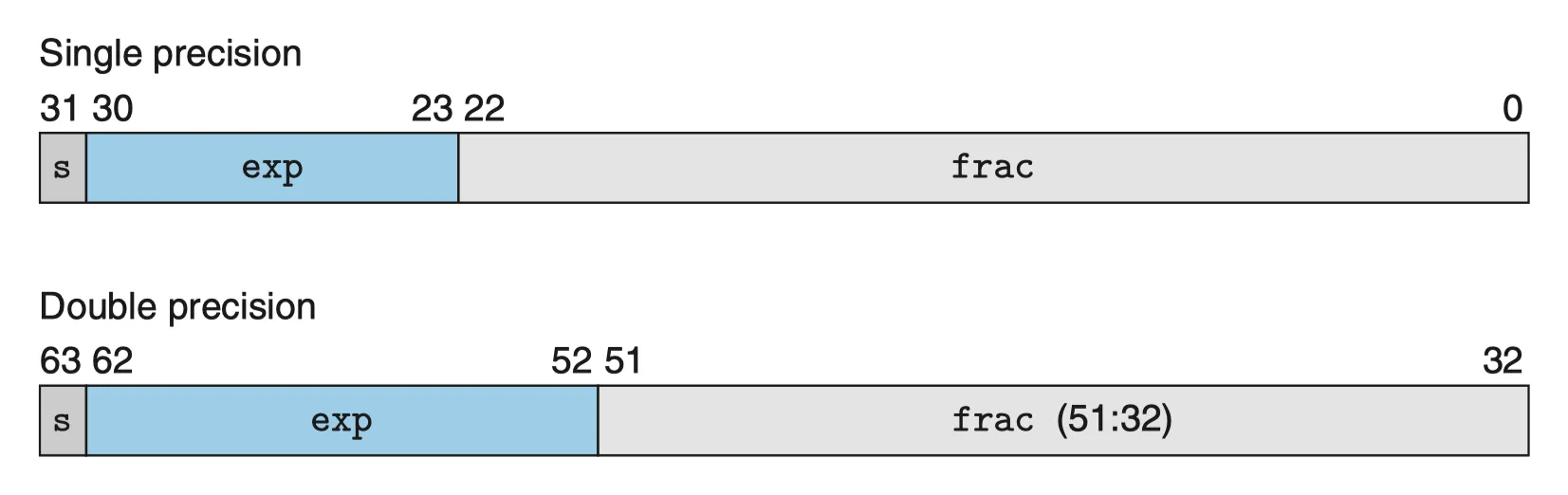 浮点数乘以 2,本质上就是指数 exp + 1。但是要特殊处理 0、非规格化数、无穷大、NaN。
- 规格化数形式是:\((-1)^s \times 1.frac \times 2^{E}\),乘以 2:\((-1)^s \times 1.frac \times 2^{E+1}\)
- 非规格化数没有隐藏的
1,它的形式是:\((-1)^s \times 0.frac \times 2^{-126}\)。所以乘以 2 时,直接让frac左移一位即可。
unsigned float_twice(unsigned uf) {
    unsigned sign = uf & 0x80000000;
    unsigned exp  = uf & 0x7f800000;
    unsigned frac = uf & 0x007fffff;

    /*
     * exp 全 1:NaN 或 infinity
     * NaN 要返回原值,infinity * 2 还是 infinity
     */
    if (exp == 0x7f800000) {
        return uf;
    }

    /*
     * exp 全 0:0 或非规格化数
     * 乘以 2 相当于 frac 左移一位
     */
    if (exp == 0) {
        frac = frac << 1;
        return sign | frac;
    }

    /*
     * 规格化数:
     * 乘以 2 相当于 exponent + 1
     */
    exp = exp + 0x00800000; // exp += 1 << 23;

    return sign | exp | frac;
}
12. float_i2f
/*
 * float_i2f - Return bit-level equivalent of expression (float) x
 *   Result is returned as unsigned int, but
 *   it is to be interpreted as the bit-level representation of a
 *   single-precision floating point values.
 *   Legal ops: Any integer/unsigned operations incl. ||, &&. also if, while
 *   Max ops: 30
 *   Rating: 4
 */
unsigned float_i2f(int x) {
unsigned sign;
unsigned ux;
unsigned tmp;
int p;
unsigned exp;
unsigned frac;
if (x == 0) {
return 0;
}
// 符号位
sign = ((unsigned)x >> 31) << 31;
// 取绝对值,注意不能直接 -x,因为 x = INT_MIN 时会溢出
if (x < 0) {
ux = ~((unsigned)x) + 1;
} else {
ux = (unsigned)x;
}
// 找最高位的 1 在哪里
// 例如 ux = 13 = 1101b,最高位位置 p = 3
p = 0;
tmp = ux;
while (tmp >>= 1) {
p++;
}
// 指数域 = E + bias
// 对整数来说,E 就是最高位 1 的位置 p
exp = (p + 127) << 23;
// 如果最高位位置 p <= 23,说明可以精确表示,不需要舍入
if (p <= 23) {
frac = (ux & ((1u << p) - 1)) << (23 - p);
} else {
// 如果 p > 23,说明有效位超过 float 的 24 位精度,需要舍入
int shift = p - 23;
// 取前 24 位:包含最高位隐藏的 1
unsigned top = ux >> shift;
// 被丢掉的低位
unsigned lost = ux & ((1u << shift) - 1);
// 正好一半的位置
unsigned half = 1u << (shift - 1);
// frac 只保留后 23 位,最高位的 1 不存
frac = top & 0x7fffff;
// round to nearest even
if (lost > half || (lost == half && (top & 1))) {
top++;
// 如果进位导致 top 变成 1000000000000000000000000b
// 说明 1.111... 舍入成了 10.000...
if (top == (1u << 24)) {
exp += 1 << 23;
frac = 0;
} else {
frac = top & 0x7fffff;
}
}
}
return sign | exp | frac;
}13. float_f2i
/*
 * float_f2i - Return bit-level equivalent of expression (int) f
 *   for floating point argument f.
 *   Argument is passed as unsigned int, but
 *   it is to be interpreted as the bit-level representation of a
 *   single-precision floating point value.
 *   Anything out of range (including NaN and infinity) should return
 *   0x80000000u.
 *   Legal ops: Any integer/unsigned operations incl. ||, &&. also if, while
 *   Max ops: 30
 *   Rating: 4
*/对于规格化浮点数:\(f = (-1)^s \times (1.frac)_2 \times 2^E\),其中:E = exp - 127
所以:
int float_f2i(unsigned uf) {
    unsigned sign = uf >> 31;
    int exp = (uf >> 23) & 0xff;
    unsigned frac = uf & 0x7fffff;

    int E = exp - 127;

    // exp 全 1:NaN 或 infinity
    if (exp == 0xff) {
        return 0x80000000u;
    }


    // exp == 0:0 或非规格数,绝对值都小于 1,转 int 为 0
    if (exp == 0) {
        return 0;
    }

    // 如果 E < 0,说明 |f| < 1,转 int 为 0
    if (E < 0) {
        return 0;
    }


    // 如果 E >= 31,超出 int 范围
    if (E >= 31) {
        return 0x80000000u;
    }


    // 规格化数的有效数字:
    // M = 1.frac * 2^23
    unsigned M = (1 << 23) | frac;
    unsigned val;


    if (E >= 23) {
        val = M << (E - 23);
    } else {
        val = M >> (23 - E);
    }


    if (sign) {
        return -val;
    } else {
        return val;
    }
}